

Window cleaning problem
Hard Water Marks on Windows
Hard-water marks are deposits left when mineral-bearing water evaporates on glass. Fresh residue can look like pale spots; repeated exposure may produce a stubborn haze or contribute to surface etching.
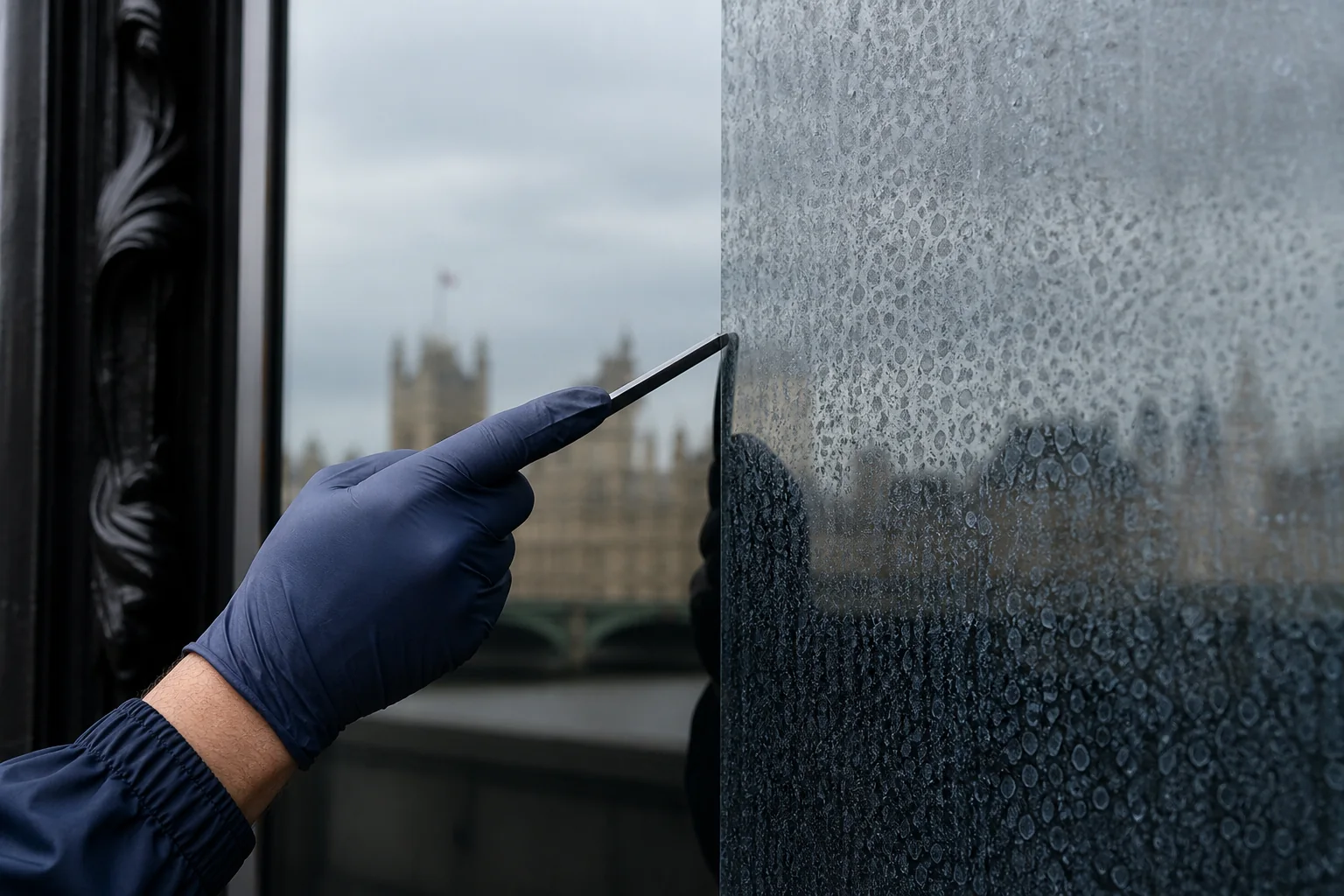
Where mineral marks come from
Garden sprinklers, leaking overflow pipes, façade runoff and repeated use of tap water can leave calcium and magnesium compounds behind. The pattern often reveals the source: arcs beside irrigation, vertical trails below masonry or dense spotting beneath a leak.
Stopping the active water source is as important as treating the visible glass. Otherwise a restored pane can develop the same deposits again.
Why routine cleaning may not be enough
Pure-water maintenance is designed to remove normal dirt without leaving new mineral residue, but it is not automatically a corrective treatment for established scale. Deposits can bond to the surface, and aggressive home remedies may damage coatings, frames or adjacent stone.
A professional should inspect the glass, confirm accessible surfaces and test a discreet area. The likely improvement can then be compared with the optical risk and cost of wider treatment.
Treatment versus replacement
Some deposits respond to controlled specialist products and mechanical polishing. Severe etching, damaged coatings or deep scratches may make restoration unsuitable, and replacement can be the more honest recommendation. Misting between panes is unrelated and needs sealed-unit repair.
No responsible provider should promise perfect removal before seeing how the glass responds. A test patch provides evidence and helps define a realistic finish.
Preventing recurrence
Redirect sprinklers, repair leaks and prevent tap-water overspray. Newly installed glass near masonry work should be protected from runoff, and exposed panes should be maintained before deposits become established.
Record the affected elevation and source so that future maintenance addresses the cause rather than repeatedly treating the symptom.
Quick comparison
| Pattern | Common source | Response |
|---|---|---|
| Circular or arcing spots | Sprinkler overspray | Redirect irrigation |
| Vertical chalky trails | Leak or masonry runoff | Repair source, then test glass |
| Uniform stubborn haze | Repeated mineral exposure | Restoration assessment |
| Moisture between panes | Failed sealed unit | Glazing repair |
Practical points to remember
- Stop the mineral-bearing water source first.
- Request a small test area before full restoration.
- Avoid untested acids, blades and abrasive powders.
- Confirm whether the glass has a special coating.
Frequently asked questions
Questions about Hard Water Marks on Windows
Can window cleaning remove hard-water marks?
Fresh residue may improve, but established deposits often require a separate restoration process.
Does pure water cause mineral spots?
Properly produced pure water contains very little dissolved mineral content and is used to avoid tap-water spotting.
Can vinegar be used on every window?
No. Coatings, frames and adjacent materials vary, so untested treatments can create damage.
Are hard-water marks permanent?
Some are removable deposits; severe exposure can etch the glass.
Why do the marks return?
The leak, sprinkler or runoff source may still be active.
Is a test patch necessary?
It is the most reliable way to judge improvement and surface response before wider work.
Need property-specific advice?